

What's the lowest-scoring question on the humor assessment?
835 responses in, and the answer surprised me.

Out of every question on the Humor Intelligence Assessment, one scores lower than all the others. Professionals average 2.52 out of 5 on it, and more than half answered “rarely” or “never.”
The question is, “I regularly take time to work on funny ideas.”
Compare that to another question, which asks whether you notice something funny in everyday moments. Professionals average 3.93 out of 5 on that one, one of the highest scores anywhere on the assessment.
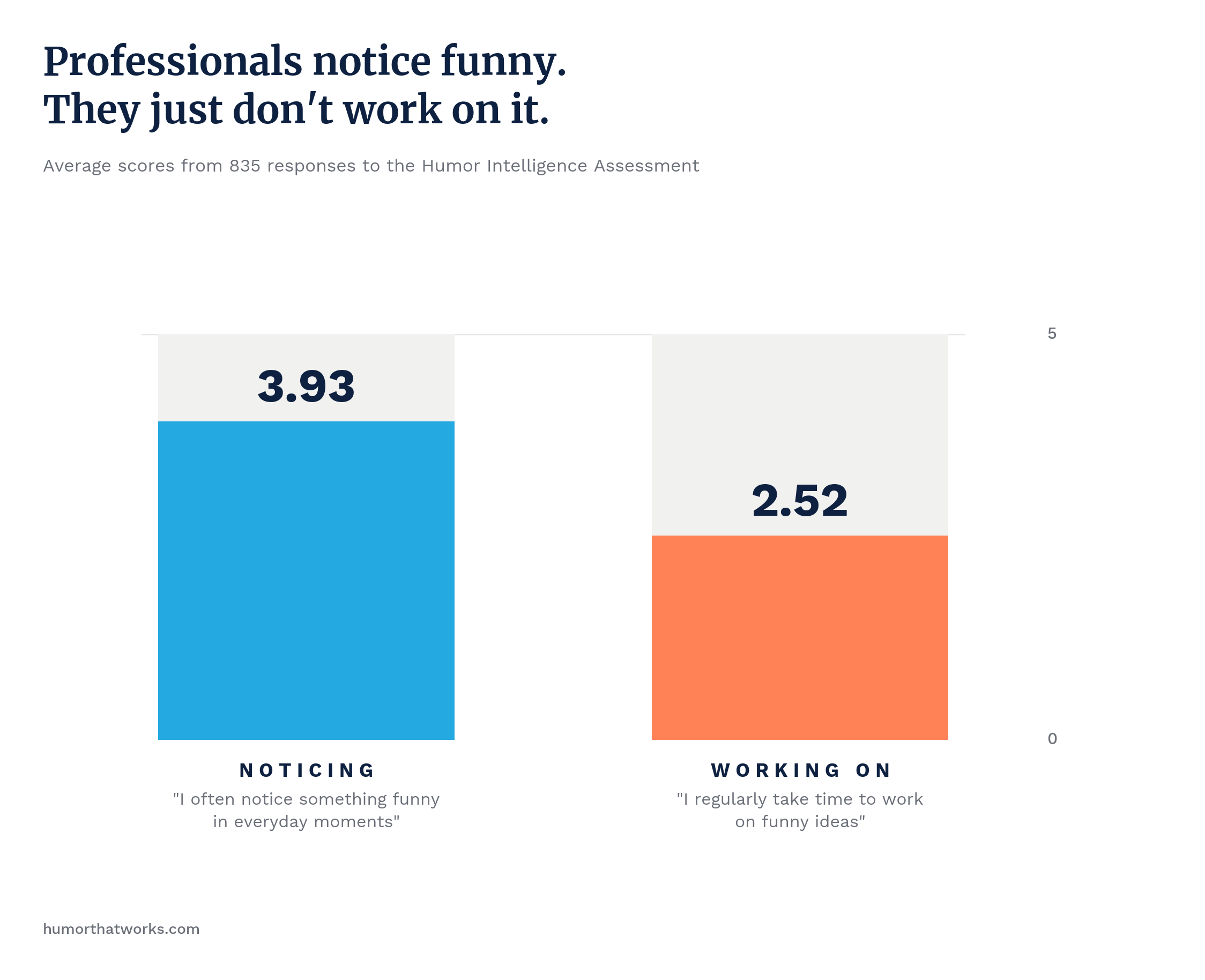
What that means is that professionals are good at spotting humor in the wild. There’s no shortage of inspiration. The problem is that it just sits there, untouched, until the idea disappears or the moment has passed.
People are building up raw material for funny that they never refine. Then they conclude from the silence that they must not be funny.
Humor is a practice, not a personality
The myth about humor is that funny people are born that way. A quick wit, natural timing, something innate. The data shows the opposite.
Many funny people have a process. They catch a moment, write it down, come back to it later, try a version, cut a word, try again, test it on someone, revise, file it away, pull it back out three months later when it finally fits.
Humor that feels spontaneous is often the output of that loop. The comedian referencing an observation they tinkered with the day before. The keynote speaker who has tested the same line in five different rooms. The friend who has been mentally editing a story since the moment it happened.
Where most professionals are lacking is exactly where the data points. They notice humor in everyday life. They almost never work on it.
What the practice actually looks like
This is why I’ve found that the fastest way for someone to improve their humor is to keep a humor notebook.

Keep a running list of observations, half-jokes, odd sentences, and weird framings that might be something in a place you can go back to. Most of what you write down may never be anything more than that. But some may end up in your presentations, conversations, or the opening of a Substack email (ahem).
Noticing is where it starts. Working on what you noticed is where the funny actually gets built.
Give it a shot
So use this email as an excuse to try it. Hit reply or leave a comment with a recent observation, moment, or half-formed thought that struck you as funny. Don’t overwork it. Don’t polish it into a joke. Just get it out of your head and onto a screen where it exists.
That’s the entire practice. Notice, capture, return to it later. The returning is where the funny gets built, but it only works if the noticing makes it out of your head first.
I’ll read every reply and help you workshop it if you’d like.
Wit regards,
-Andrew
P.S. If you haven’t taken the Humor Intelligence Assessment yet, you can here. Five minutes, eight competencies, and a profile of where your own humor skills actually sit.
Why aren't these articles or parts of them written in a funny way?