

Your drawing is nice, which means you worked hard
There's something wrong with that sentence.

Pineapple (my daughter) had her first full day of kindergarten yesterday.
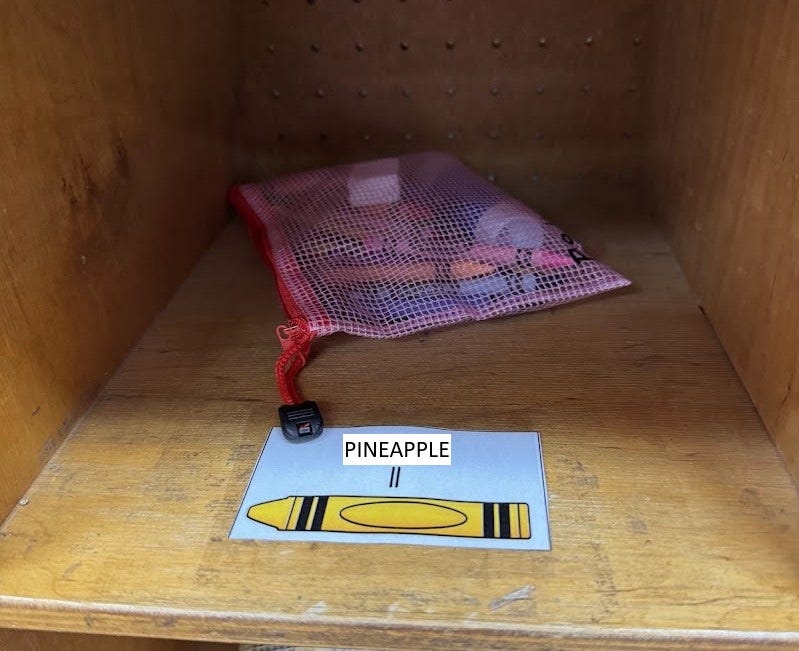
It was a big day for all of us (more so for us than her). Excitement, anxiousness, and that specific feeling you get watching a five-year-old walk into a very large school wearing a very large backpack, with a very large realization that “our little girl is growing up.”
Pretzel (my wife) and I were the first parents in the pickup line. Pineapple was the first kid out… which I’m choosing to interpret as a sign of enthusiasm rather than escape.
We walked home and celebrated with cake. (We have a cake and champagne tradition for big moments in our house, and at five she gets the cake half, we do the champagne part later.)
Then we asked about her day.
She gave us the highlights, which were mostly the new playground at recess. She gave us a few of the hard parts too, and one detail that wasn’t a highlight or a hard part, just a thing that happened.
Somewhere in the middle of the day the class was coloring, and her teacher told her, “your drawing is nice, which means you worked hard.”
Pretzel and I had the same reaction about four seconds apart. The teacher’s comment is backwards.
The sentence, the other way around
“You worked hard, and your drawing is nice.”
Same words, opposite lesson.
The teacher’s version implied that the result was what determined whether or not she worked hard. But you can work hard on something and it can turn out to be... well, let’s just say not good. But you still should encourage the effort.
The flipped version makes the effort the thing that happened, and the drawing just the thing that came out of it.
In fairness to her teacher, it was her first full day too, and the first week back involves a certain amount of rust for everyone in the building. (I’ve given talks in August, I know.) She was complimenting a kindergartner’s coloring. Nobody should go to jail.
But it’s where it starts.
Kindergarten here is more structured than Pretzel expected. Assigned seats. Sitting. Listening to the teacher. None of which is bad, five-year-olds do need some of it, and I’m not going to argue for twenty unsupervised kindergartners running on the honor system.
It’s just tough to argue with a German when she knows the entire history of the man who invented kindergarten (Friedrich Fröbel) and gave us the word for it (kindergarten = children’s garden).
But what starts with a phrase like the teacher’s, and keeps going through twenty more years of rooms like that, is a slow education in creating two versions of yourself.
Work self vs home self
On Tuesday I ran the first session of a ten-week program with twenty-two people in it, and early on I asked what had stopped them from using more humor at work.
Not one person said “I’m not funny.”
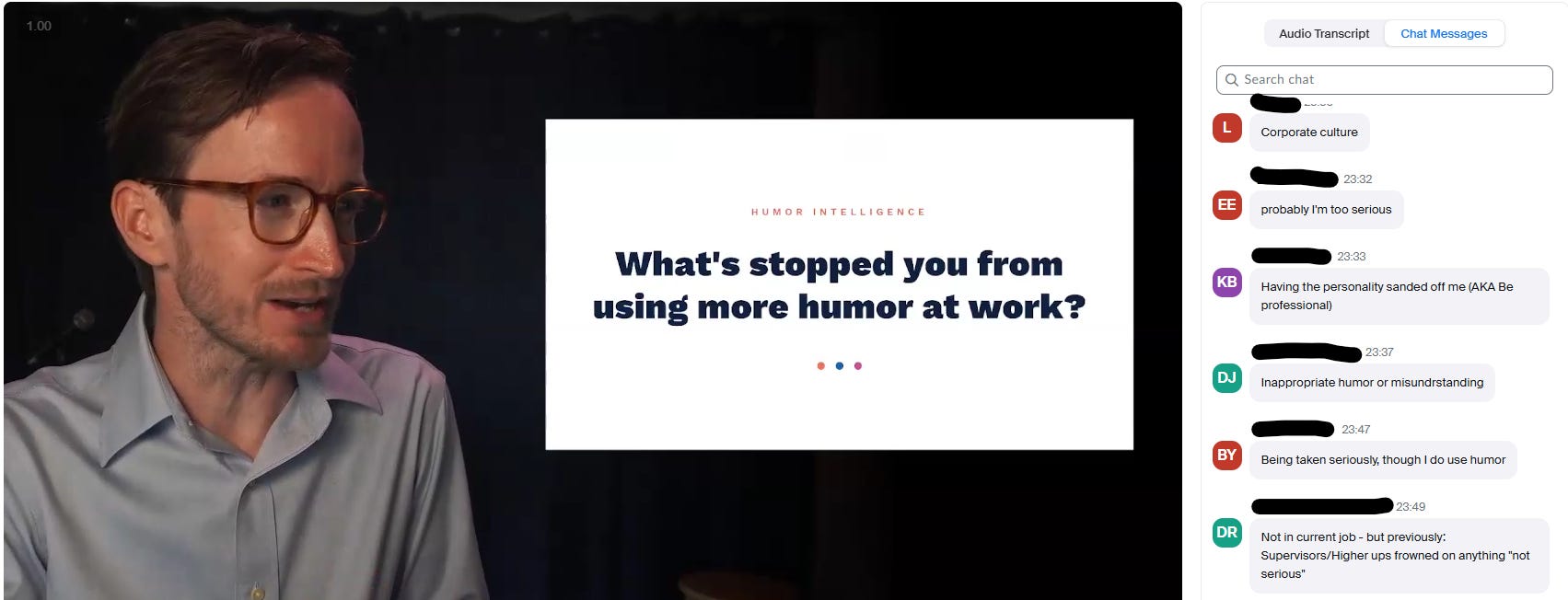
One wrote, “having the personality sanded off me,” and then supplied her own translation, “AKA be professional.” Another wrote that her supervisors frowned on anything not serious. Someone else wrote “corporate culture,” which I think we can all translate without help.
Every answer was about the room.
And these are funny people. They were funny in the chat, they were funny at me for a full hour, and I’d bet every one of them is funny at dinner with people they’ve known for ten years.
Somewhere along the way they each learned there were certain rooms (or entire buildings) where it felt like they needed to leave their humor outside.
They hadn’t lost anything. They knew exactly where it was, stuffed behind a corporate facade.
Data-backed split personalities
The biggest issue in using humor isn’t that people don’t know how to. It’s that they don’t take what works with their friends and apply it at work.
Which is convenient, because the gap between the two is measurable, and it only takes about ten minutes.
Take the Humor Intelligence Assessment twice.

The first time, answer as your work self, the one who shows up on the Tuesday call. Then take it again and answer as the version of you who shows up with people you’ve known for a decade.
Then look at the gap.
Someone in our Humor Intelligence cohort did exactly that, once as her serious professional self and once as her creative self, and the two scores came back about forty points apart. Same person, same week, same test.
That may not be the same for everyone, but whatever your gap turns out to be, read it the way we wanted her teacher to read the drawing. The number isn’t a verdict on how funny you are. It’s a record of where you’ve been putting the reps.
So if you have a low work score and a high off-duty score, that means the skill already exists. That may have taken years to develop, but transferring it to a new room takes about as long as deciding to.
And if both come back low, that’s a more honest starting point than most people get, and it’s just as fixable.
Your reps this week
Think about where you’re already funny. Be specific about it. The group chat with three people in it, the one coworker who gets your references, the drive home when no one else can hear you. That’s your home stage.
Notice what you actually do there, because you’re not “trying to be funny,” you’re doing something specific. You do voices, say the thing everyone is thinking, or call back to something from four months ago that nobody else remembered.
Bring one of those into your work. Not at the all-hands, but in your next one-on-one, the next Slack thread, or the next “time management” meeting that starts eight minutes late.
You can do the first two right now, as you read this. The third one is the only one that costs anything, and worst case scenario, it costs about four seconds of feeling weird.
After we ate cake, Pineapple also taught us a song she’d learned at school called “It’s Time for Music Class.” Then she taught us the dance, which she made up. Then all three of us did the dance together. For about 25 minutes.
My goal is that she always feels comfortable being herself. So far so good.
Color me hopeful,
-Andrew
P.S. I’d like to know which room you’re already funny in. Hit reply and tell me. Group chat, dinner table, the drive home, whatever it is. No assessment required for that one.
P.P.S. I now know every word of “It’s Time for Music Class.” And if you can read that title, you do too.